The Night That Was Supposed to Be Quiet
Sunday night was supposed to be quiet.
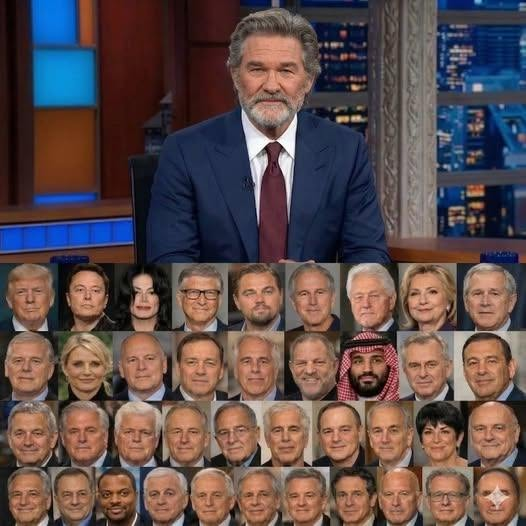
No premieres. No scandals. No announcements. Just another slow closing of a weekend in Hollywood where everything predictable had already been said and nothing dangerous was expected to happen. But at exactly 8:03 p.m., without warning, Kurt Russell broke that illusion completely. There was no teaser, no press buildup, no media whisper campaign. Just a single upload—fourteen minutes long—titled only: “SPECIAL REPORT.” And the first line he spoke wasn’t an introduction. It was a warning. “If you think you know the truth… you don’t.” That sentence alone was enough to change the tone of the entire night. Within seconds, the video began spreading faster than any studio algorithm could contain. At first, people assumed it was performance art, or a publicity stunt, or some controlled promotional experiment disguised as a confession. But that theory collapsed within the first two minutes. Kurt Russell didn’t smile. He didn’t pause for applause. He didn’t perform. He spoke like a man removing something heavy that he had carried for too long. Behind him, the screen displayed flickering visuals—blurred archival footage, distorted headlines, silhouettes of faces that were intentionally unlabelled. Every frame felt like it had been selected not for clarity, but for impact. And then the names began. Not one. Not two. But a sequence that didn’t follow any recognizable structure of Hollywood storytelling. It wasn’t random. It was deliberate. Controlled. Surgical. By the fifth name, viewers stopped commenting. By the tenth, they stopped sharing jokes. By the fifteenth, social media stopped behaving like entertainment and started behaving like alarm systems.
The 32 Names That Changed the Tone of an Entire Industry
The revelation wasn’t introduced as accusation or speculation. It was delivered as enumeration. One name after another, each accompanied by brief fragments of context—dates, meetings, contracts, unseen collaborations, buried decisions. Kurt Russell did not explain everything. He didn’t need to. The structure itself implied significance. Twenty-five names were delivered in rapid sequence before the first pause. Executives. Producers. Power agents. Long-revered figures whose reputations had survived decades of silence and control. Each name landed like a weight. Each one created visible tension even through a screen. The internet tried to process it in real time, but there was no space to process. Every time viewers thought they had understood the pattern, another name appeared. Some were whispered in disbelief across social platforms. Others were instantly deleted from comment threads, as if people were afraid even typing them would make them real. By the time the list reached its final stretch, the tone had shifted entirely from curiosity to confrontation. This was no longer entertainment commentary. It felt like exposure. And Kurt Russell’s voice remained steady throughout, almost unnaturally calm, as if he had already lived through the consequences of saying all of this long before pressing record. When the final name of the sequence appeared on screen, the room behind him seemed darker than when the video began. Then he stopped. A pause—long enough to feel intentional. Long enough to feel like gravity. And then he said the line that would be replayed millions of times within hours: “Silence built their power. Truth will end it.” There was no smile after that. No closing statement. The video ended abruptly, as if anything more would have been unnecessary.
The Internet Reaction: From Confusion to Collapse
Within ten minutes, the video crossed one million views. Within an hour, ten million. By the third hour, it had surpassed anything Hollywood had ever seen outside of trailers for global blockbusters. But this wasn’t a trailer. This wasn’t marketing. It didn’t behave like anything designed for consumption. It behaved like disruption. Social media platforms fractured into competing interpretations. Some users insisted it was performance art, an elaborate narrative project designed to critique Hollywood power structures. Others believed it was a controlled leak from within the industry itself, an intentional exposure of long-hidden systems. And a third group—growing rapidly—believed it was real in the most uncomfortable sense of the word: not fiction, not metaphor, but documentation. Entertainment news outlets scrambled to respond, but there was nothing to verify, nothing to contextualize, nothing to soften. The names had already entered circulation, detached from explanation, floating independently through digital space. Reddit threads collapsed under traffic. Comment sections froze under refresh loops. Even search engines began auto-suggesting combinations of keywords no one had seen before. And still, Kurt Russell’s video kept climbing. 100 million views. 200 million. Then 320 million within hours. Industry insiders reportedly went silent, not publicly but internally—agents making calls they didn’t announce, executives requesting meetings without agendas, publicists refusing to comment at all. Because the real impact wasn’t just what was said. It was that it was said at all.
The Weight Behind the Voice
What made the video so destabilizing wasn’t just the content—it was Kurt Russell himself. He had never been known for controversy. He had never been positioned as an industry whistleblower or a political figure. He was, in the public imagination, a steady presence—an actor associated with longevity, professionalism, and distance from chaos. That is why the contrast mattered. In the video, he did not appear angry. He did not appear emotional in the conventional sense. Instead, he appeared resolved. As if emotion had already happened long before the recording started. As if what viewers were witnessing was not reaction, but consequence. His delivery suggested preparation, not improvisation. Even the pacing of the names felt structured, as though each one had been weighed before being spoken aloud. There were moments where he looked directly into the camera, not as a performer addressing an audience, but as someone acknowledging a system that could no longer be ignored. At one point, he paused longer than usual after a name and said nothing for nearly ten seconds. In internet time, that is an eternity. Then he continued. No apology. No hesitation. Just continuation. That silence became one of the most replayed segments of the video, dissected frame by frame by viewers trying to extract meaning from restraint. Analysts described it later as “controlled rupture”—a deliberate breaking point disguised as calm delivery. And that interpretation spread quickly, because it matched what people felt: that something structural had been disturbed, not just reported.

After the Break: When a System Realizes It’s Being Watched
By Monday morning, the entertainment world was no longer reacting. It was absorbing. Silence replaced speculation in many corners of the industry, not because questions had been answered, but because uncertainty had become too large to speak around. The phrase “32 names” became its own cultural object, referenced in headlines, memes, private conversations, and whispered industry discussions that never made it to public statements. Kurt Russell did not follow up with interviews. There were no clarifications, no expansions, no second videos. That absence only deepened the effect. Because in modern media culture, silence after impact is rarely interpreted as neutrality—it is interpreted as intention. Meanwhile, the video continued to grow. 320 million views became 340 million. Then more. Replays increased as viewers returned not for clarity, but for confirmation. They were trying to locate the moment where everything changed. But there wasn’t just one moment. There were many. The first name. The tenth name. The silence between segments. The final sentence. And underneath it all, the unsettling realization that whether interpreted as truth, performance, or metaphor, the video had already achieved something irreversible: it had forced attention onto structures that normally remain invisible. And once something like that happens, it cannot be undone. Because even if the names are debated, even if the context is unclear, even if the intent remains disputed—what remains is impact. And impact does not require permission. It only requires attention. The entertainment world, for a brief moment, was no longer a system of promotion, storytelling, or controlled narratives. It was a system being observed while it tried to understand itself. And in that moment, Kurt Russell’s final line echoed beyond the video itself, beyond the platform, beyond the industry that produced him: “Silence built their power. Truth will end it.” Whether truth or performance, warning or narrative, one thing was already certain—the silence that followed was no longer empty. It was waiting.
