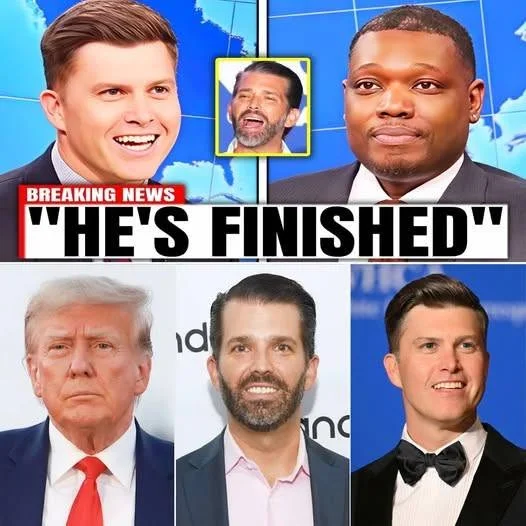
Late-night television has always been a place where politicians, celebrities, and public figures become the target of sharp jokes and unexpected criticism. But every once in a while, a comedy segment becomes something bigger than entertainment. It becomes a cultural moment that dominates conversations far beyond the studio walls.
That was the atmosphere surrounding one of the most talked-about Saturday Night Live moments in recent memory.
The night began like any other episode. The audience settled into their seats, the lights dimmed, and the familiar energy of live comedy filled the studio. But when the opening monologue turned its attention toward Donald Trump and his family, the mood shifted almost instantly.
The jokes were fast. The delivery was sharp. And the reactions were immediate.
Within minutes, clips from the segment began spreading across social media, sparking arguments between supporters and critics, with millions of viewers debating whether SNL had delivered a legendary political roast or crossed another line in the never-ending battle between comedy and politics.
At the center of the controversy was Donald Trump Jr., who has frequently criticized the long-running NBC comedy show and accused it of unfairly targeting his family.
The latest round of jokes once again placed him and former President Donald Trump directly in the spotlight, with the show using its trademark combination of satire, exaggeration, and political humor to comment on the family’s public image.
The audience reaction inside the studio was immediate.
Laughter filled the room as the hosts delivered jokes aimed at everything from political controversies to the Trump family’s constant presence in the media. The performance relied on the same formula SNL has used for decades: take the biggest names in American culture, highlight their most recognizable moments, and turn them into comedy.
But outside the studio, the reaction was far more divided.
For critics of Trump, the segment represented exactly what they believe SNL does best—using humor to challenge powerful figures and expose what they see as contradictions in politics.
For Trump supporters, however, the jokes were another example of what they describe as a long-running pattern of hostility toward conservatives and the Trump family.
The debate quickly moved beyond comedy.

For years, Donald Trump and Saturday Night Live have had one of the most complicated relationships in modern political entertainment.
Trump himself appeared on the show as a host in 2015, before winning the presidency. At the time, the appearance generated massive attention and became one of the most discussed episodes of the season.
But after his political rise, the relationship changed dramatically.
SNL became one of the most visible platforms for political satire against Trump, with impersonations, sketches, and monologues frequently focusing on his presidency, his public statements, and his battles with the media.
Trump repeatedly criticized the program, arguing that the show unfairly mocked him and demanded consequences for NBC.
SNL, meanwhile, continued doing what it has done throughout its history—turning political conflict into comedy.
That tension created a cycle that benefited both sides.
The show gained attention whenever it targeted Trump, while Trump gained another opportunity to criticize mainstream media and connect with his supporters.
It became a familiar pattern in American culture: a politician attacks the comedian, the comedian responds with more jokes, and the public watches the conflict unfold.
What made this particular episode different was not only the jokes themselves, but the timing.
The Trump family has remained one of the most recognizable political families in America, with every public appearance, statement, and controversy receiving intense media attention.
Donald Trump Jr., in particular, has become a prominent voice among Trump supporters, frequently defending his father and criticizing opponents through interviews, social media posts, and public appearances.
That visibility also makes him a natural target for political comedians.
Comedy often works by focusing on people who are already impossible to ignore.
The bigger the public figure, the bigger the reaction.
And when the target is someone connected to Donald Trump, the response is almost guaranteed to be intense.

Inside the studio, the performers leaned into the moment.
The jokes were designed to create strong reactions. The audience laughed loudly, the hosts maintained their trademark confidence, and the segment moved quickly from one punchline to another.
But behind every political comedy sketch is a larger question:
Does satire simply make people laugh, or does it influence how people view public figures?
Supporters of political comedy argue that humor has always played an important role in democracy. From newspaper cartoons to late-night television, comedians have long challenged leaders by making them appear less untouchable.
They argue that laughter can reveal flaws, question authority, and encourage people to think critically.
Critics, however, argue that political comedy has become increasingly one-sided and contributes to deeper divisions between Americans.
They believe shows like SNL often reinforce existing opinions rather than changing minds.
Both sides agree on one thing:
The influence of late-night comedy is impossible to ignore.

As clips from the episode spread online, the conversation grew larger than the original broadcast.
Some viewers called it one of the strongest political comedy performances in years.
Others accused the show of continuing a pattern of targeting one side of the political spectrum.
Social media became the battlefield where supporters and critics exchanged opinions, shared clips, and debated whether the jokes represented fearless comedy or political bias.
That is the unique power—and controversy—of modern entertainment.
A five-minute comedy segment can become a national conversation within hours.
A joke delivered on a stage in New York can spark debates across millions of screens around the country.

Whether people loved it or hated it, the latest Trump-focused SNL segment proved something that has been true for decades:
Political comedy remains one of the most powerful forms of cultural commentary in America.
The jokes may disappear after the weekend.
The headlines may eventually fade.
But the larger conversation about politics, media, celebrity, and public criticism continues.
Because in today’s America, a comedy sketch is rarely just a comedy sketch.
Sometimes it becomes a symbol.
Sometimes it becomes a battle.
And sometimes, for better or worse, it becomes the story everyone is talking about.
