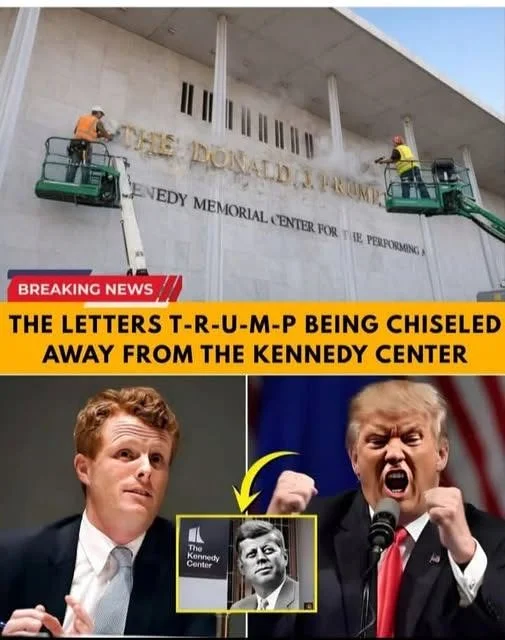
THE TRASH HAS BEEN COLLECTED: Kennedy Center Finally Scrubs the Stain of Trump From Its Walls!
The John F. Kennedy Center for the Performing Arts has long stood as a symbol of American culture, creativity, and artistic excellence. For decades, it has welcomed performers, musicians, actors, and audiences from every background, serving as a place where art could unite people regardless of politics. Yet in recent years, debates surrounding the institution have increasingly become entangled with the nation’s political divisions, particularly those connected to former President Donald Trump.
Now, critics and supporters alike are reacting to what some are calling a dramatic turning point. Headlines and social media posts have erupted with declarations that the Kennedy Center has finally “scrubbed the stain of Trump from its walls,” framing recent developments as a symbolic effort to distance one of America’s most prestigious cultural institutions from the controversies that have surrounded the former president.
For many Americans, Donald Trump remains one of the most polarizing figures in modern political history. His supporters praise him as a political outsider who challenged the establishment and reshaped national conversations on immigration, trade, and government spending. His critics, however, argue that his rhetoric and conduct damaged democratic norms and deepened political divisions throughout the country.
The Kennedy Center found itself pulled into these national debates during Trump’s presidency. Traditionally, presidents and first ladies have participated in the institution’s annual honors and celebrations. During Trump’s time in office, however, tensions between the administration and many prominent artists became increasingly visible. Several performers publicly criticized the president, while others declined invitations connected to official events.
As a result, the relationship between the White House and the cultural community grew more strained than many observers could remember. What had once been viewed as a largely ceremonial and bipartisan connection became another front in America’s broader political conflict.
Recent changes at the Kennedy Center have reignited these discussions. Supporters of the institution argue that it is returning to its primary mission: promoting artistic achievement rather than becoming a battleground for partisan politics. They believe the center should focus on celebrating creativity, preserving cultural heritage, and supporting artists rather than being associated with any single political figure.
Critics of Trump have gone even further. Many have described the latest developments as a long-overdue correction, claiming that the institution’s reputation suffered during years of political controversy. To them, the removal of symbols, references, or influences associated with Trump represents a fresh start and a reaffirmation of the center’s cultural values.
Trump supporters, however, strongly reject such characterizations. They argue that describing the former president as a “stain” is unfair and politically motivated. In their view, efforts to erase or diminish his presence reflect ongoing attempts by political opponents to rewrite history or exclude perspectives they disagree with. They contend that cultural institutions should remain open to all Americans, regardless of political affiliation.
The debate highlights a larger question facing many public institutions today: Can cultural organizations remain neutral in an era of intense political polarization? Museums, universities, libraries, and arts organizations across the country have increasingly found themselves caught between competing expectations. Some audiences demand that institutions take strong positions on social and political issues, while others insist that they remain above partisan conflicts.
The Kennedy Center’s situation demonstrates just how difficult that balance can be. Every decision—whether related to leadership, programming, partnerships, or public statements—can quickly become the subject of national political debate. In today’s media environment, even routine institutional changes can be interpreted through a partisan lens.
Despite the controversy, many arts advocates hope the conversation will eventually return to the center’s core mission. The Kennedy Center was established to honor the legacy of President John F. Kennedy and to promote the performing arts throughout the United States. Its stages have hosted world-class performances, celebrated legendary artists, and inspired generations of audiences.
Whether one views the recent developments as a victory, a mistake, or simply another chapter in America’s ongoing political drama, one thing is clear: the Kennedy Center remains a powerful symbol of the nation’s cultural identity. The strong reactions from all sides demonstrate how deeply intertwined politics and culture have become in modern America.
As the institution moves forward, the challenge will be preserving its artistic mission while navigating the political pressures that increasingly surround public life. The debate over Trump’s legacy at the Kennedy Center may continue for years, but the broader question remains unchanged: should America’s cultural landmarks reflect political movements, or should they stand apart from them?
For now, the conversation shows no sign of ending—and the Kennedy Center once again finds itself at the center of a national debate far bigger than the walls that house its stages.
